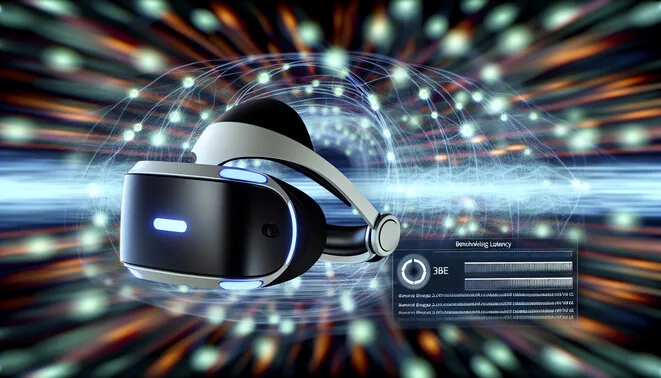
Understanding VR Latency Basics
Latency in virtual reality (VR) is a critical factor that influences user experience, primarily defined by metrics like motion-to-photon delay. This delay represents the time taken from a user’s physical movement to the corresponding visual update in the headset. For optimal performance, latencies below 20 milliseconds are generally acceptable, while anything above 30 milliseconds can lead to noticeable lag, causing motion sickness and disorientation for users [Source: Scaler].
Motion-to-photon latency comprises several components—sensor latency, processing delay, and display latency. Sensor latency is the time taken for the system to detect and process movement. Processing delay occurs as the system calculates the necessary visual changes based on the user’s input. Finally, display latency is the time required for the visuals to render on the VR headset [Source: Road to VR].
Key Factors Impacting Latency Performance
Latency performance in VR headsets is significantly influenced by several critical factors, primarily network jitter, packet loss, and software optimizations:
- Network Jitter: This refers to the variation in time delays in packet delivery over a network, which can adversely affect the seamless experience needed for virtual reality. More consistent latency can be achieved through protocols like IEEE 802.1Q, which helps prioritize VR data packets over less critical traffic.
- Packet Loss: Packet loss occurs when data packets traveling across a network fail to reach their destination, which can severely impact the quality of the VR experience. Techniques such as forward error correction (FEC) can help mitigate the effects of packet loss.
- Software Optimizations: VR systems are often heavily software-dependent, making optimizations a critical factor in reducing latency. Low-latency protocols like WebRTC can facilitate faster communication between VR devices [Source: Cloudflare Article].
Benchmarking Methodologies and Tools
Measuring latency effectively is crucial, particularly in environments leveraging 2.5 GbE (Gigabit Ethernet) technology. Various benchmarking methodologies and tools can aid in this process:
- Frame-by-Frame Analysis: This technique involves capturing and analyzing frames transmitted over the network at the micro-level using tools like Wireshark.
- Specialized Latency Testing Tools: Devices designed for measuring network latency, such as Ixia’s latency testers, can perform sophisticated analyses.
- Traffic Generators: Tools like JPerf simulate traffic loads on a network to test its responsiveness.
- Latency Measurement Standards: Following methodologies defined by the IETF ensures consistent and replicable latency tests.
Hardware Considerations for Optimal Results
To achieve optimal results in VR environments, several hardware components are crucial for minimizing delays and enhancing overall performance:
- Display Technology: High-resolution displays with low refresh rates significantly reduce latency. Technologies like OLED and Mini LED are ideal for immersive environments.
- Tracking Systems: Accurate tracking systems, such as those in the Oculus Quest series, maintain immersion without lag due to their internal tracking capabilities.
- Network Interfaces: A robust networking setup is crucial for VR experiences, with wired connections generally providing lower latency than Wi-Fi.
- Processing Power: Modern GPUs, like NVIDIA’s RTX series, are essential for rendering high-quality graphics in real time [Source: AI Impact Article].
Industry Trends and Future Outlook
The landscape of virtual reality (VR) is evolving rapidly, with several key trends shaping its future. One significant development is the integration of cloud-based VR solutions, allowing users to engage in immersive experiences from anywhere [Source: Forbes].
Artificial intelligence (AI) is optimizing VR experiences by enhancing graphics rendering and personalizing user interactions. A study by TechRadar highlights how AI will refine the development of realistic environments in VR.
Moreover, the rise of 2.5 GbE technology is providing faster data transfer rates, reducing latency and enabling smoother interactions. Reports suggest that this technology is becoming more accessible, enhancing high-performance VR applications [Source: Network World].
As these trends continue to develop, the future of VR looks promising, shaped by cloud capabilities, AI advancements, and enhanced networking technologies [Source: Automation Article].
Sources
- AnandTech – Why 2.5 Gigabit Ethernet is the Next Big Thing in Networking
- Forbes – The Top 5 Cloud Computing Trends in 2023
- Ixia – Latency Testing
- Network World – What’s New in Going Faster with 2.5GbE
- Road to VR – Understanding Latency in VR
- Scaler – What is Latency in Virtual Reality
- TechRadar – AI is the Future of Game Development
- IETF – RFC 2681: A Two-Rate Three-Color Marking Algorithm
“`