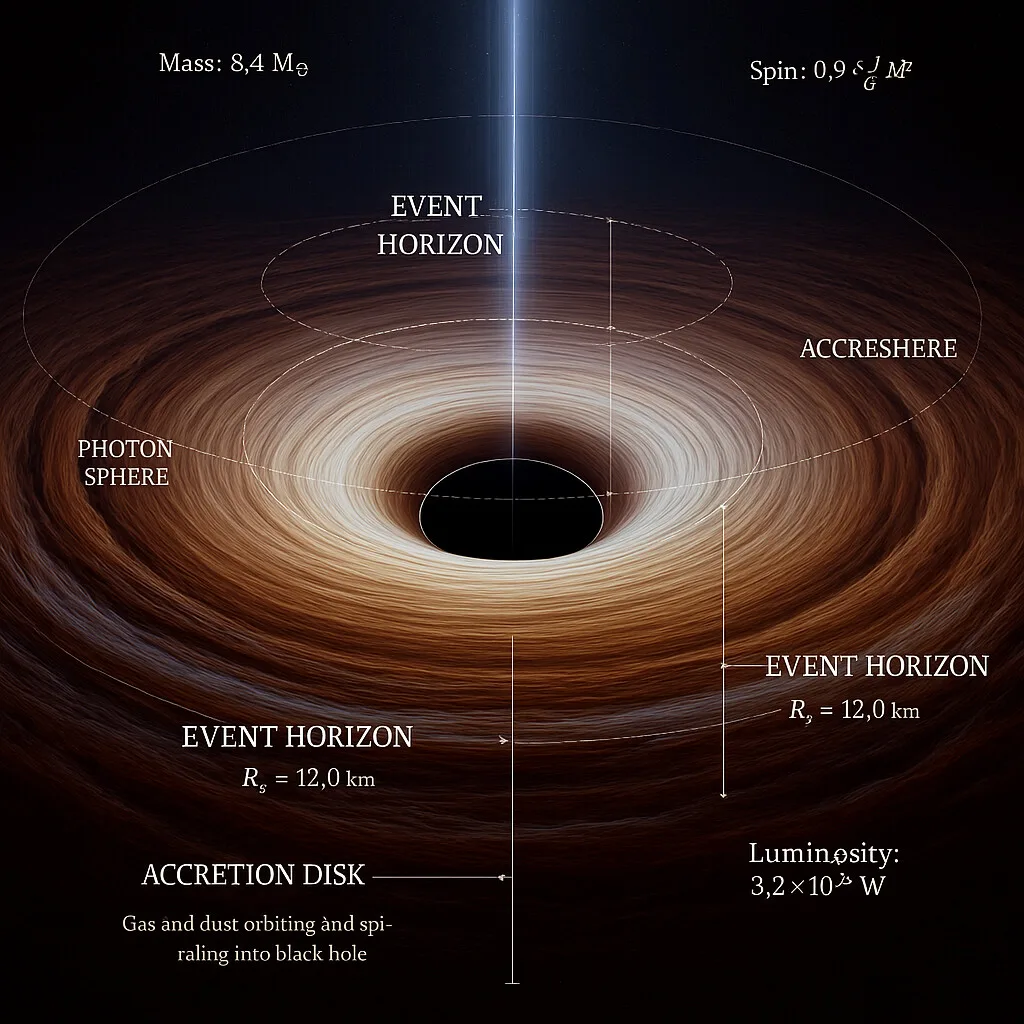
Abstract: In this in-depth exploration of black hole physics, we delve into the concepts surrounding event horizons. We begin by discussing general relativity’s perspective on what lies within and beyond these boundaries before moving onto quantum mechanics’ implications. Then, we explore the holographic principle as proposed by string theory and its potential applications near a black hole singularity. Finally, we examine the implications of gravitational wave astronomy in understanding cosmic phenomena like black holes.
Introduction:
Black holes are among the most fascinating objects in our universe. With such intense gravity that not even light can escape once it crosses their event horizons, they continue to intrigue astronomers and physicists alike. Yet, despite decades of research into these cosmic entities, many questions remain unanswered about what exactly happens beyond their enigmatic event horizons.
In this article, we aim to provide a comprehensive look at the theories proposed by various scientific disciplines concerning phenomena occurring within and outside black holes’ boundaries. From the perspective of general relativity, which describes gravity as warping spacetime around massive objects like black holes, to quantum mechanics, which introduces an inherent uncertainty principle affecting measurements taken near such extreme environments, we will attempt to offer a clearer understanding of these mysteries.
The Event Horizon: A Window into the Unknown
From Einstein’s theory of general relativity, it is clear that any matter or radiation crossing the event horizon of a black hole would be pulled towards its singularity at the center. The notion suggests that once something crosses this boundary, there is no escaping gravity – information cannot escape and time becomes severely distorted due to extreme density and curvature of space-time.
However, not all theories agree on what happens after crossing an event horizon. Quantum mechanics introduces a different perspective where particles can potentially be in two places at once, suggesting that information might be stored differently than predicted by general relativity alone. This ambiguity creates tension between these seemingly opposing views, leaving room for speculative interpretations about potential existence of ‘hidden’ layers or structures beyond the singularity itself.
String Theory and the Holographic Principle: A New Frontier in Understanding Gravity
One promising direction towards reconciling quantum mechanics with gravity comes from string theory, which postulates that fundamental particles are not points but tiny strings vibrating at different frequencies. These vibrations correspond to various types of particles we observe under our everyday reality – electrons, quarks, photons etc. However, this requires a more comprehensive understanding of spacetime than what is currently available.
One intriguing aspect of string theory is the concept known as ‘holography’. According to this principle, all information contained within an object could potentially be encoded on its surface. This idea has been extended beyond three dimensions into higher dimensional spaces often referred to as ‘bulk’, where a region inside the black hole might contain complete information about everything outside it – much like data recorded onto a hologram containing the entirety of visual details despite being confined to two-dimensional space.
The holographic principle has significant implications for understanding gravity near singularities, suggesting that the information paradox associated with black holes may have an elegant solution rooted in quantum mechanics and not purely within the realm of general relativity as previously believed.
Gravitational Wave Astronomy: A New Era in Space-Time Observation
Observations from gravitational wave astronomy provide further insight into cosmic phenomena involving massive objects like black holes. Detecting ripples in space-time generated during these events offers a unique window into high-energy physics beyond traditional electromagnetic observations.
By studying the mergers of two black holes or neutron stars, we gain knowledge about their properties and behavior under extreme conditions not easily accessible through other means. For instance, knowing more about how they accrete mass and how this affects their spins could shed light on what happens at singularities themselves, further illuminating our understanding of the universe’s most enigmatic phenomena – black holes.
Conclusion:
While much progress has been made in exploring black hole physics, many questions remain unanswered due to limitations imposed by current observational capabilities and technological advancements. As we continue advancing instruments like LIGO and future missions aiming at directly observing cosmic phenomena without any interference, we may uncover more answers about what lies beyond the event horizons of these cosmic gatekeepers.