
Modern astrophysics stands at the precipice of revolutionary discoveries that challenge our fundamental understanding of reality itself. Recent breakthroughs in black hole research, coupled with emerging theories about parallel universes, are reshaping how we perceive space, time, and the very nature of existence. From the detection of ultramassive black holes weighing 36 billion times our sun’s mass to quantum computing experiments that may provide evidence for parallel realities, we are witnessing an unprecedented convergence of observational astronomy and theoretical physics that could unlock the deepest mysteries of the cosmos.[1][2][3]
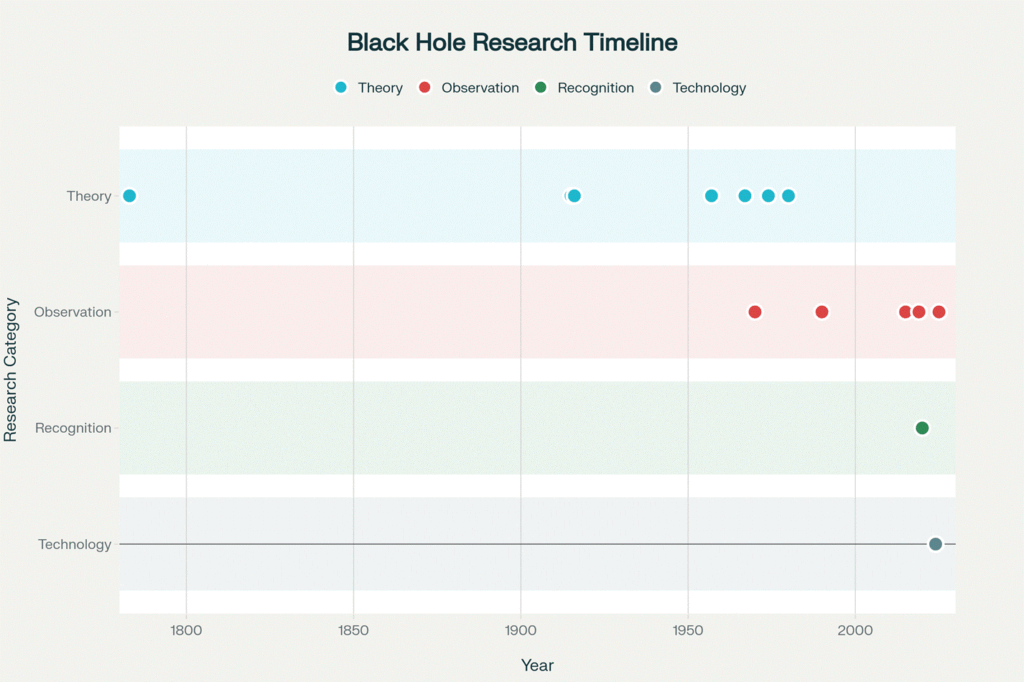
Timeline of Major Breakthroughs in Black Hole and Multiverse Research (1783-2025)
The Architecture of Spacetime’s Most Extreme Objects
Beyond the Event Horizon: Modern Black Hole Physics
Black holes represent the most extreme manifestation of Einstein’s general relativity, where spacetime curvature becomes so intense that it creates an inescapable gravitational prison. The event horizon, that infamous boundary beyond which nothing can return, continues to yield new insights as our observational capabilities advance dramatically. Recent research has fundamentally challenged our understanding of these cosmic behemoths, revealing that they are far more complex and dynamic than previously imagined.[4][5][6][7]
The traditional view of black holes as simple, “bald” objects characterized only by mass, charge, and spin has given way to a more nuanced picture. Modern quantum gravity theories suggest that black holes possess “quantum hair” – subtle imprints of information encoded in their gravitational fields that preserve details about the matter that formed them. This revelation directly addresses the famous Hawking information paradox, which has puzzled physicists since Stephen Hawking first described how black holes should radiate energy while simultaneously destroying information.[3][7][8]
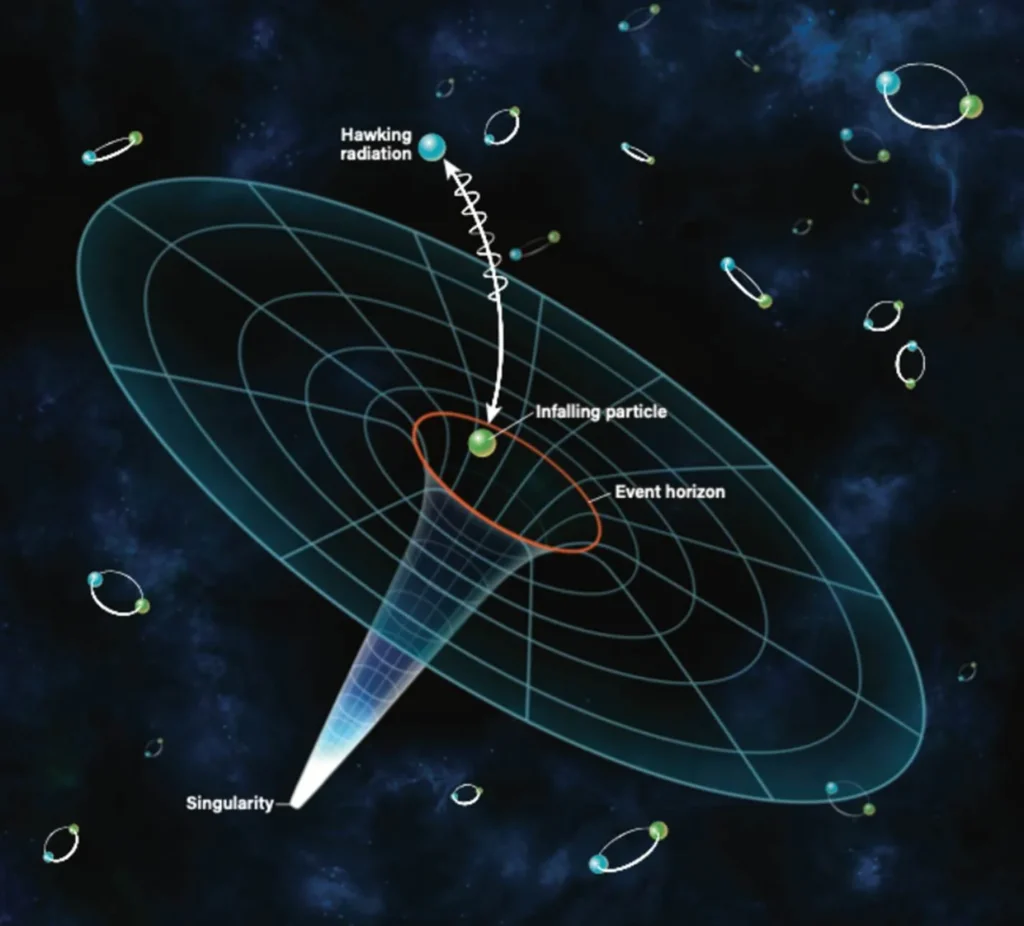
Illustration of Hawking radiation showing particle pairs near a black hole’s event horizon, with one particle escaping as radiation and the other falling into the singularity.
The structure surrounding black holes proves equally fascinating and complex. Accretion disks, those swirling maelstroms of superheated matter spiraling into the void, serve as cosmic particle accelerators that can launch jets of material at nearly the speed of light. These jets, extending thousands of light-years into space, provide crucial insights into the magnetic fields and plasma dynamics near event horizons. Recent observations by the Event Horizon Telescope collaboration have revealed magnetic field strengths of 2.6 tesla near black hole event horizons – roughly 400 times stronger than Earth’s magnetic field – powerful enough to halt material from falling directly into the black hole and instead channel it into these spectacular jets.[5][9][10]
The Discovery of Cosmic Giants
The past year has witnessed extraordinary discoveries that have redefined the upper limits of black hole masses. The identification of what may be the most massive black hole ever discovered – a cosmic behemoth containing approximately 36 billion solar masses – has challenged theoretical models of black hole formation and growth. This ultramassive object, residing in the galaxy at the heart of the “Cosmic Horseshoe” gravitational lens system, possesses roughly 10,000 times the mass of Sagittarius A*, the supermassive black hole at our galaxy’s center.[1][11]
Even more remarkable is the discovery of ancient black holes that formed when the universe was merely 500 million years old – just 3% of its current age. These early giants, some weighing up to 300 million solar masses, present a profound puzzle: how did such massive objects form so quickly after the Big Bang? The rapid growth required challenges our understanding of accretion processes and suggests that either black hole seeds were much more massive than previously thought, or that alternative formation mechanisms operated in the early universe.[12][13][14][15]
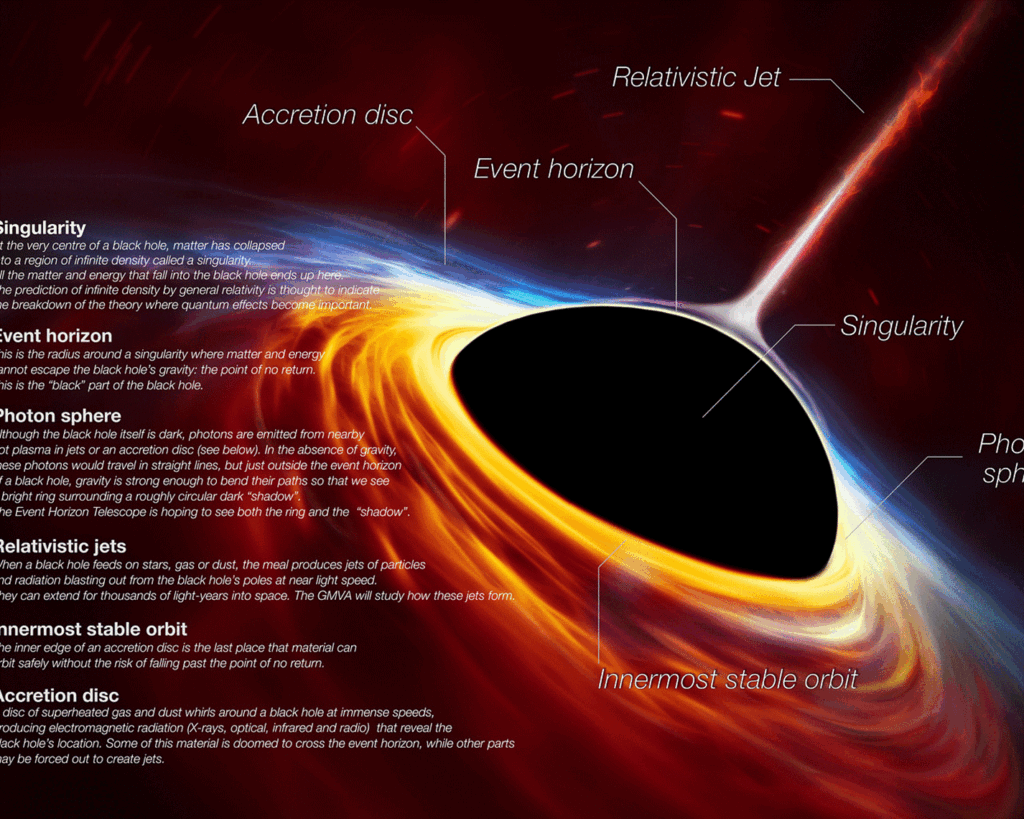
Illustration of a supermassive black hole highlighting the accretion disc, event horizon, singularity, photon sphere, innermost stable orbit, and relativistic jets.
Quantum Mechanics and the Birth of Parallel Realities
The Many-Worlds Revolution in Physics
While black holes represent extreme manifestations of gravity, quantum mechanics has given birth to equally revolutionary concepts that challenge our understanding of reality itself. The many-worlds interpretation of quantum mechanics, first proposed by Hugh Everett III in 1957, suggests that every quantum measurement causes the universe to split into multiple branches, each containing a different outcome. This interpretation has evolved from a philosophical curiosity into a serious scientific framework with potential experimental consequences.[16][17][18][19]
The implications of many-worlds theory extend far beyond academic speculation. If valid, it means that every decision you’ve ever made, every quantum event that has ever occurred, plays out in countless parallel universes. In some branches, you chose a different career; in others, historical events unfolded differently; in still others, the fundamental laws of physics themselves may vary. This creates what cosmologists call the Level III multiverse – a vast ensemble of parallel realities connected through the abstract mathematical space of quantum mechanics.[18][20][16]
Recent work by researchers at UC Davis has provided new insights into how classical reality might emerge from this quantum multiverse. Their mathematical models suggest that rather than simply splitting into alternate universes or collapsing into single outcomes, quantum systems can produce different results depending on the “filter” used to observe them. This finding implies that multiple realities may coexist without being able to interact with each other, providing a potential explanation for why we experience a single, consistent reality despite living in a multiverse.[19][21]
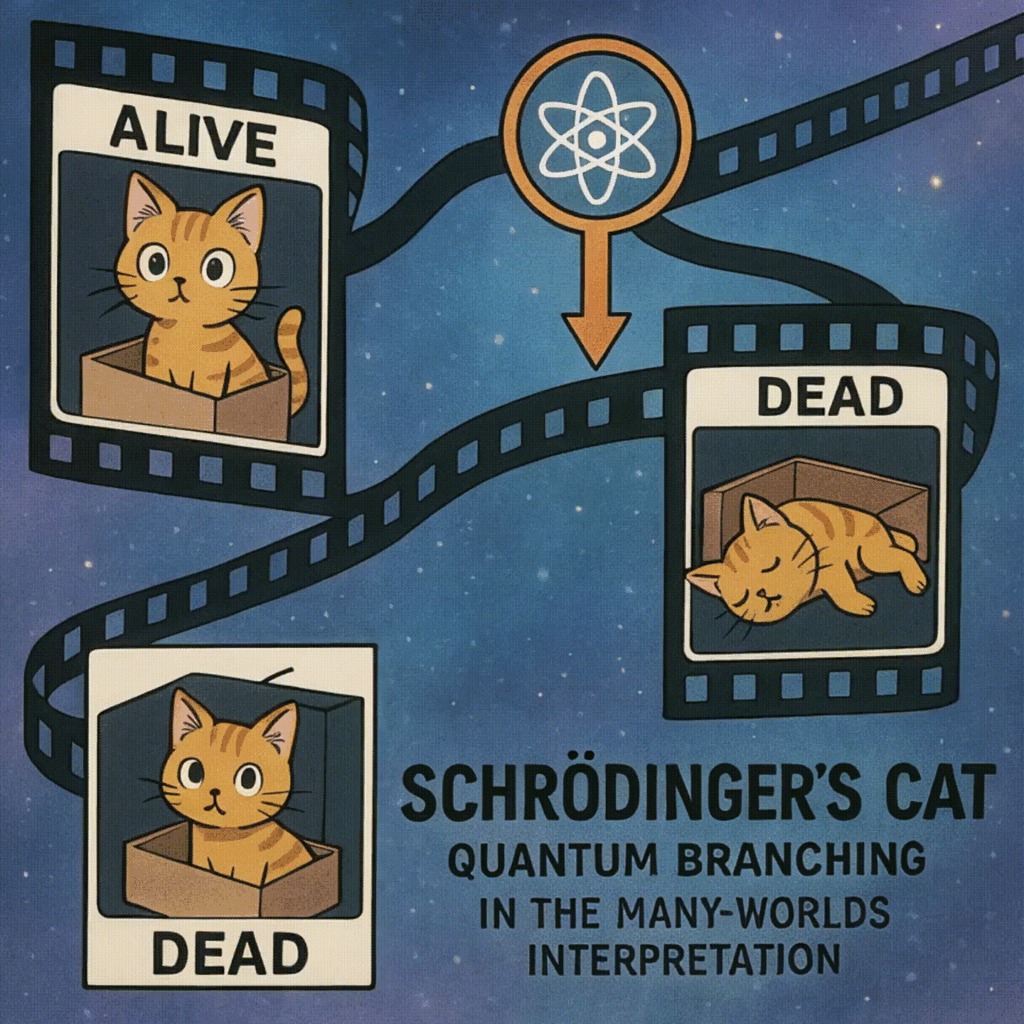
A filmstrip illustration depicting Schrödinger’s Cat thought experiment representing quantum branching in the many-worlds interpretation.
Quantum Computing and Multiverse Evidence
The intersection of quantum computing and multiverse theory reached a dramatic crescendo with Google’s announcement of their Willow quantum chip, which solved a computational problem in under five minutes that would require the world’s fastest supercomputers approximately 10 septillion years to complete. Hartmut Neven, founder of Google’s Quantum AI team, boldly claimed that this achievement “lends credence to the notion that quantum computation occurs in many parallel universes”.[2]
This assertion reignited intense debates within the scientific community about the nature of quantum computation and its relationship to parallel realities. Supporters of the multiverse interpretation argue that the exponential speedup demonstrated by quantum computers can only be explained if qubits are simultaneously processing information across multiple parallel universes. Critics counter that alternative interpretations of quantum mechanics, such as the Copenhagen interpretation or pilot-wave theories, can account for these phenomena without invoking parallel worlds.[2]
The controversy highlights a fundamental tension in modern physics: while quantum computers demonstrably achieve computational advantages that seem impossible within a single universe, the multiverse interpretation remains unproven. However, the practical implications are undeniable – quantum computers are essentially using the multiverse as a parallel computing cluster, whether or not parallel universes actually exist in the literal sense.[21][2]
The Thermodynamics of Infinite Realities
Information Paradoxes and Cosmic Censorship
The relationship between black holes and the multiverse becomes particularly intriguing when examining questions of information preservation and thermodynamics. Hawking’s original calculation suggested that black hole evaporation through quantum radiation would destroy information – a conclusion that violates fundamental principles of quantum mechanics. However, recent advances in quantum gravity theory have provided potential resolutions that preserve both information and the consistency of physical laws.[7][8][22][23]
The key insight involves recognizing that quantum corrections to Einstein’s equations modify Hawking radiation in subtle but crucial ways. Instead of being purely thermal and information-free, quantum-corrected Hawking radiation carries correlations that encode information about the black hole’s interior. This “quantum hair” allows black holes to evaporate completely while preserving all information about their formation and evolution.[3][8][24]
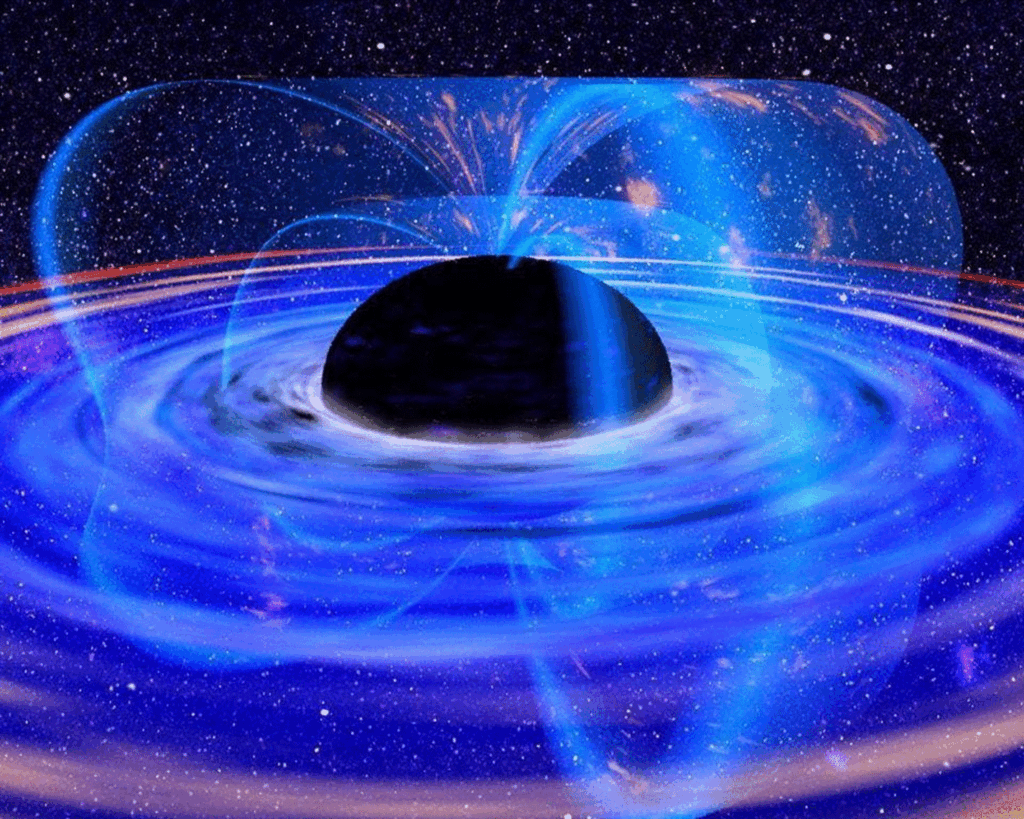
Scientific illustration of a black hole with accretion disk and magnetic field lines in space.
These developments have profound implications for our understanding of spacetime and causality. If information is indeed preserved in black hole evaporation, it suggests that the universe maintains a complete record of all quantum events – essentially creating a cosmic library that stores every possible outcome across all parallel realities. This perspective aligns remarkably with certain interpretations of the multiverse, where information about all possible quantum branches must be preserved somewhere in the broader structure of reality.[7][8][16][21]
The Emergence of Classical Reality
One of the most challenging aspects of multiverse theory involves explaining why we experience a single, classical reality despite potentially living in a superposition of countless quantum states. Recent research using sophisticated computer simulations has provided new insights into this puzzle, suggesting that classical worlds naturally emerge from quantum multiverse dynamics through a process similar to statistical thermodynamics.[19]
The key mechanism involves the inherent randomization of quantum phases at microscopic scales, which leads to stable macroscopic structures that behave classically. This process creates distinct branches of reality that cannot interact with each other, effectively isolating different quantum outcomes into separate classical worlds. Remarkably, the same mathematical framework predicts that some branches will experience entropy increase (like our universe) while others experience entropy decrease, creating a multiverse with opposing arrows of time.[19]
Cosmic Inflation and Eternal Expansion
The Inflationary Multiverse Paradigm
The concept of cosmic inflation, first proposed by Alan Guth in 1980, has evolved into one of the most compelling frameworks for understanding both the structure of our universe and the potential existence of parallel realities. Inflation theory suggests that the early universe underwent a period of exponential expansion, during which quantum fluctuations were stretched to cosmic scales and became the seeds for galaxies and large-scale structure.[16][20]
However, inflation theory carries profound implications that extend far beyond our observable universe. If inflation is eternal – continuing indefinitely in some regions while ending in others – it creates an infinite ensemble of “bubble universes,” each with potentially different physical laws and constants. This Level II multiverse represents one of the most scientifically grounded proposals for parallel realities, as it emerges naturally from well-established physics rather than philosophical speculation.[17][18][16]
Recent observations of the cosmic microwave background radiation have provided strong support for the basic inflationary paradigm, while also hinting at features that could indicate interactions with other bubble universes. Although no definitive evidence for bubble collisions has been detected, ongoing surveys continue to search for the subtle signatures that such encounters might leave in the cosmic microwave background.[25][16]
String Theory and the Landscape of Possibilities
String theory, humanity’s most ambitious attempt to unify quantum mechanics with gravity, predicts an astronomical number of possible vacuum states – potentially 10^500 different configurations of space-time geometry and physical constants. This “string landscape” suggests that the inflationary multiverse could contain bubble universes with an almost unimaginable diversity of physical properties.[18]
In some regions of the multiverse, the force of gravity might be stronger or weaker; the mass of electrons could be different; even the dimensionality of space-time itself might vary. This framework provides a potential explanation for why our universe seems so perfectly tuned for the existence of life – among the vast ensemble of possibilities, some regions will inevitably possess the precise conditions necessary for complexity and consciousness to emerge.[20][26][18]
The string landscape also offers intriguing connections to black hole physics. Different regions of the multiverse could contain black holes with fundamentally different properties, some maintaining singularities while others, governed by modified gravitational theories, remain perfectly regular throughout their interiors. This diversity could provide natural laboratories for testing the most extreme predictions of quantum gravity theory.[23][24][27]
Observational Horizons and Future Discoveries
The Event Horizon Telescope and Beyond
The Event Horizon Telescope’s groundbreaking images of black holes have ushered in a new era of observational black hole physics. These direct observations of the “shadows” cast by black holes provide unprecedented tests of Einstein’s general relativity in the strongest gravitational fields in the universe. Current projects aim to extend these capabilities further, creating the first movies of black hole dynamics and potentially observing the birth and death of accretion flows in real-time.[5][6]
Future expansions of the Event Horizon Telescope network will enable observations of black hole jets and magnetic field structures with even greater precision. These observations could provide crucial tests of quantum gravity theories by detecting subtle deviations from classical predictions near event horizons. Such measurements might even reveal signatures of quantum corrections to black hole spacetimes, providing the first observational evidence for effects that have previously existed only in theoretical calculations.[6][24][27][5]
The next generation of gravitational wave detectors promises equally revolutionary discoveries. The planned LISA mission will detect gravitational waves from merging supermassive black holes throughout cosmic history, providing a census of black hole formation and growth across billions of years. These observations could reveal whether the ultramassive black holes recently discovered represent a distinct population or simply the extreme tail of the supermassive black hole distribution.[1][28]
Quantum Experiments and Multiverse Tests
While direct observation of parallel universes may seem impossible by definition, several proposed experiments could provide indirect evidence for multiverse theories. David Deutsch has outlined a theoretical test that could distinguish between single-universe and many-worlds interpretations of quantum mechanics through carefully designed interference experiments. Although technically challenging, such experiments represent the first serious attempts to empirically test multiverse theories.[21][29][30]
The rapid advancement of quantum computing technology offers another avenue for exploring multiverse implications. As quantum computers become more powerful and sophisticated, they may enable simulations of quantum systems complex enough to test specific predictions of many-worlds theory. Google’s Willow chip represents just the beginning of this technological revolution, with future quantum computers potentially capable of solving problems that provide more definitive evidence about the structure of quantum reality.[2][21]
Implications for Fundamental Physics
Unification and the Theory of Everything
The convergence of black hole physics and multiverse theory represents more than academic curiosity – it points toward potential pathways for achieving the ultimate goal of theoretical physics: a complete theory of quantum gravity. String theory, loop quantum gravity, and other approaches to unification all make specific predictions about black hole structure and the nature of spacetime that could be tested through the observations and experiments discussed above.[23][24][27]
The discovery of quantum corrections to black hole physics has already provided crucial insights into how quantum mechanics and gravity might be unified. These findings suggest that the resolution of fundamental paradoxes – such as the information problem and the nature of singularities – requires understanding both quantum mechanics and gravity as aspects of a more fundamental theory.[7][8][24][23]
Similarly, multiverse theory provides a new framework for understanding why the laws of physics take their observed forms. Rather than requiring fine-tuning or intelligent design, the multiverse offers a naturalistic explanation for cosmic coincidences through the anthropic principle – we observe a universe conducive to life simply because universes hostile to observers contain no one to make observations.[18][25][26]
Philosophical and Existential Implications
The implications of black hole and multiverse research extend far beyond physics into fundamental questions about the nature of existence, consciousness, and reality itself. If the many-worlds interpretation is correct, every quantum event creates new branches of reality, meaning that countless versions of ourselves exist across parallel universes. This raises profound questions about personal identity, moral responsibility, and the uniqueness of our experiences.[18][20][26]
The potential existence of infinite parallel realities also challenges traditional concepts of probability and statistical inference. In an infinite multiverse, every possible event occurs infinitely often, making conventional probability theory problematic. This has led to new approaches to cosmological modeling that attempt to make sense of probabilities and predictions in infinite ensembles.[16][31]
Black holes present equally challenging philosophical puzzles. The possibility that information is preserved in Hawking radiation suggests that the universe maintains perfect records of all events, creating a form of physical determinism that could have implications for concepts of free will and causality. Meanwhile, the existence of event horizons creates regions of spacetime forever disconnected from external observation, raising questions about the relationship between physical reality and observational accessibility.[7][8][32][33]
The Road Ahead: Challenges and Opportunities
Technological Frontiers
The next decade promises unprecedented advances in our ability to study both black holes and quantum systems. Advanced gravitational wave detectors will provide detailed maps of black hole populations throughout cosmic history. Improved quantum computers may enable direct tests of multiverse theories. New telescopes and interferometers could detect subtle signatures of parallel universes in the cosmic microwave background.[2][6][16][21][25][28]
Perhaps most excitingly, the convergence of these technologies may enable entirely new types of experiments and observations. Quantum sensors could detect gravitational effects near black holes with unprecedented precision. Machine learning algorithms trained on multiverse simulations might identify patterns in astronomical data that reveal signatures of parallel realities. The intersection of quantum information theory and general relativity continues to generate new insights into the fundamental structure of spacetime.[6][19][21][22][27][33][34]
Unresolved Questions and Future Directions
Despite remarkable progress, many fundamental questions remain unanswered. How exactly do quantum corrections resolve black hole singularities? Can we directly observe signatures of parallel universes in quantum experiments? What is the ultimate fate of information in evaporating black holes? How do classical worlds emerge from quantum multiverse dynamics?[7][8][19][21][23][24][29]
The search for answers to these questions drives ongoing research across multiple disciplines, from theoretical physics to observational astronomy to quantum computing. Each new discovery reveals additional layers of complexity while simultaneously providing new tools for exploration. The landscape of possibilities continues to expand as our technological capabilities advance and our theoretical understanding deepens.[2][5][6][18][21][24][27]
Conclusion: At the Edge of Understanding
We stand at a remarkable moment in the history of science, where our most sophisticated theories and most advanced technologies are converging on fundamental questions about the nature of reality itself. Black holes, once purely theoretical constructs, have become laboratories for testing the most extreme predictions of physics. Parallel universes, once confined to science fiction, now represent serious scientific hypotheses with potential experimental consequences.[2][5][6][8][21][27][29]
The attached diagram illustrating black hole structure, with its detailed depiction of event horizons, accretion disks, and the various zones surrounding these cosmic giants, represents just the beginning of our journey into these extreme realms. As we develop ever more sophisticated tools for observation and computation, we move closer to understanding not just what black holes are, but what they reveal about the deepest structures of spacetime and quantum reality.[6][24][27][35]
The multiverse, whether realized through quantum branching, cosmic inflation, or mathematical necessity, challenges us to expand our conception of existence beyond the boundaries of our observable universe. These parallel realities may forever remain beyond direct observation, but their theoretical implications continue to reshape our understanding of physics, philosophy, and our place in the cosmic order.[18][19][20][21][25][26]
As we continue to push the boundaries of knowledge, the relationship between black holes and the multiverse will undoubtedly yield new surprises and deeper insights. The universe – or multiverse – appears to be far stranger, more complex, and more wonderful than we ever imagined. Our journey of discovery has only just begun, and the most profound revelations may still lie ahead as we venture deeper into these cosmic frontiers where space, time, and reality itself are redefined.[8][19][21][24][27][2][6][18]
⁂
- The-concept-of-the-multiverse-has-i.txt
- scientific-black-hole-diagram-with-comprehensive-technical-specifications.jpg
- https://link.aps.org/doi/10.1103/PhysRevD.110.063553
- https://ras.ac.uk/news-and-press/research-highlights/most-massive-black-hole-ever-discovered-detected
- https://www.skyatnightmagazine.com/space-science/accretion-disk
- https://phys.org/news/2024-12-event-horizon-telescope-black-hole.html
- https://science.nasa.gov/blogs/webb/2025/07/15/nasas-webb-finds-possible-direct-collapse-black-hole/
- https://www.reddit.com/r/explainlikeimfive/comments/1gkn516/eli5_why_a_black_hole_creates_an_accretion_disk/
- https://www.reddit.com/r/AskPhysics/comments/1biuehh/is_a_black_holes_event_horizon_inescapable/
- https://www.space.com/astronomy/black-holes/scientists-find-oldest-known-black-hole-in-the-universe-this-is-about-as-far-back-as-you-can-practically-go
- https://en.wikipedia.org/wiki/Accretion_disk
- https://arxiv.org/abs/2307.13489
- https://www.wired.com/story/this-is-probably-the-most-massive-black-hole-in-history-gravitational-lens/
- https://www.britannica.com/science/accretion-disk
- https://www.physicsforums.com/threads/challenging-the-notion-of-crossing-a-black-holes-event-horizon.1067166/
- https://news.berkeley.edu/2025/05/08/not-one-but-two-massive-black-holes-are-eating-away-at-this-galaxy/
- https://phys.org/news/2024-10-event-horizon-black-holes-scientists.html
- https://www.npr.org/2025/08/13/nx-s1-5500427/oldest-known-supermassive-black-hole
- https://www.nbcnews.com/science/space/black-hole-scientists-dawn-universe-first-days-space-capers-lrd-z9-rcna223694
- https://thequantuminsider.com/2024/12/16/googles-quantum-chip-sparks-debate-on-multiverse-theory/
- https://nypost.com/2020/05/19/nasa-finds-evidence-of-parallel-universe-where-time-runs-backward-report/
- https://tothenetwork.com/multiverse-theory-implications-and-debates/
- https://en.wikipedia.org/wiki/Multiverse
- https://www.youtube.com/watch?v=c08Zzc0xepI
- https://nautil.us/even-physicists-find-the-multiverse-faintly-disturbing-236365/
- https://www.scientificamerican.com/article/heres-why-we-might-live-in-a-multiverse/
- https://www.npr.org/2011/01/24/132932268/a-physicist-explains-why-parallel-universes-may-exist
- https://ruth-dm.co.uk/posts/welcome-to-the-multiverse/
- https://www.ucdavis.edu/blog/new-thinking-about-multiverse
- https://www.forbes.com/sites/jamiecartereurope/2022/06/13/have-scientists-found-a-mirror-world-parallel-universe-that-explains-everything-the-truth-behind-the-headlines/
- https://www.reddit.com/r/askscience/comments/6hk9s4/does_multiverse_theory_allow_for_variation_in_the/
- https://physics.aps.org/articles/v17/155
- https://www.reddit.com/r/AskPhysics/comments/1dnqp0f/proving_or_suggesting_alternate_universes_exist/
- https://en.wikipedia.org/wiki/Black_hole_information_paradox
- https://arxiv.org/html/2508.08006v1
- https://www.space.com/astronomy/black-holes/this-is-the-holy-grail-of-theoretical-physics-is-the-key-to-quantum-gravity-hiding-in-this-new-way-to-make-black-holes
- https://www.popularmechanics.com/space/deep-space/a43519907/black-hole-paradox-stephen-hawking-finally-solved/
- https://link.aps.org/doi/10.1103/PhysRevD.111.024013
- https://scitechdaily.com/no-more-singularities-quantum-gravity-could-finally-solve-the-black-hole-mystery/
- https://www.scirp.org/journal/paperinformation?paperid=49079
- https://arxiv.org/pdf/2402.00818.pdf
- https://quantumzeitgeist.com/new-black-hole-solutions-emerge-from-quantum-gravity-calculations/
- https://physics.mit.edu/wp-content/uploads/2023/09/PhysicsAtMIT_2023_Engelhardt_Feature.pdf
- https://cmsa.fas.harvard.edu/event/general-relativity-seminar-5724/
- https://arxiv.org/abs/2507.15795
- https://www.popularmechanics.com/space/a65292231/quantum-gravity-black-hole-solutions/
- https://ppl-ai-code-interpreter-files.s3.amazonaws.com/web/direct-files/693f48cbd784c1fa3cdd7048e44692b7/b91d98b2-bb89-48af-85e1-0fb67565c2b0/18a2db67.csv
- https://ppl-ai-code-interpreter-files.s3.amazonaws.com/web/direct-files/693f48cbd784c1fa3cdd7048e44692b7/b91d98b2-bb89-48af-85e1-0fb67565c2b0/34e31bc7.csv



You must be logged in to post a comment.